

Audio Cables & Connections
Cables and Connections in Audio | With so many different types of cables available. It is therefore not always easy to determine whether “Which type of cable is the best cable?” because there are other factors to consider as well, mainly for example cable length. And compatible devices, etc. Therefore, in this article. We’ll talk about “cables” and “connections” in the sound system. to increase understanding and use it to get the most efficiency When you’re ready.. Let’s follow together in this article.
Balanced & Unbalanced
Before we delve into the details. Of the different types of cables, there is another important issue that is the “ signal format ” of each type of cable. All of which are divided into 2 forms as follows:
Balanced cable
Balanced cables are designed to avoid the problem of external electrical interference, especially Inside consists of 3 signal wires: Ground (Shield), positive signal (Hot), and negative signal (Cold).
The working principle of the Balanced cable is that when transmitting a signal through a Balanced cable, it will cause noise or noise from outside to reverse phase. and a clearing occurred. until only the input signal remains which when the signal is sent to the destination The receiving device will reverse phase. The result is The signal sent after the phase reversal, the signal is twice as strong and clear, is described by the electrical equation as follows:

Unbalanced signal cable
Unbalanced signal wires have only one positive ( Hot) and one Ground (Shield) signal wire.
The working principle of the Unbalanced signal cable is not as complicated as Balanced, that is, the positive signal cable is a signal cable used to transmit signals. Without going through any phase reversals and there will be only a Ground cable that is a shield cable to prevent signal interference. The limitation of the Unbalanced cable is the length of the cable. If the cable is longer, the noise will increase as well.
In general, what we can see often, the cables that are used frequently in the home and in the consumer level are mostly unbalanced cables, including those used with musical instruments, for example, electric guitars and bass, etc. But when in a situation that must be used with professional audio work, Balanced cables therefore come into play a lot, such as being used as a signal cable. for the quality of the sound signal that is good
cable type
Now that we understand the difference between balanced and unbalanced cables, let’s move on. That there are different types of cables in the sound system.
TS

TS cables, shortened to Tip/Sleeve, often referred to as “guitar strings” or “instrument strings”, are a type of unbalanced cable with a mono (1 channel) audio connection that should not be used at high wattage. Very long, should be as short as possible. Because as I mentioned in the previous section that length of wire If the longer the cable, the more Noise will increase as well, with the TS cable having a 1/4″ (6.3mm) jack.
TRS

Although visually, TRS cables may look similar to TS cables, the difference is noticeable. Because there are 2 black marks on the jack head TRS cable, or shortened to Tip / Ring / Sleeve, is a Balanced signal cable with a positive, negative and ground signal cable as a single TRS cable component. It can also be used to connect Mono (1 channel) or Stereo (2 channels) signals that we often see in professional audio systems. There is also a 3.5mm size for the Headphone cable, but it will be an Unbalanced signal because TRS (3.5mm) will consist of a 2-pole positive cable and a ground cable only. But it can still transmit stereo.
XLR

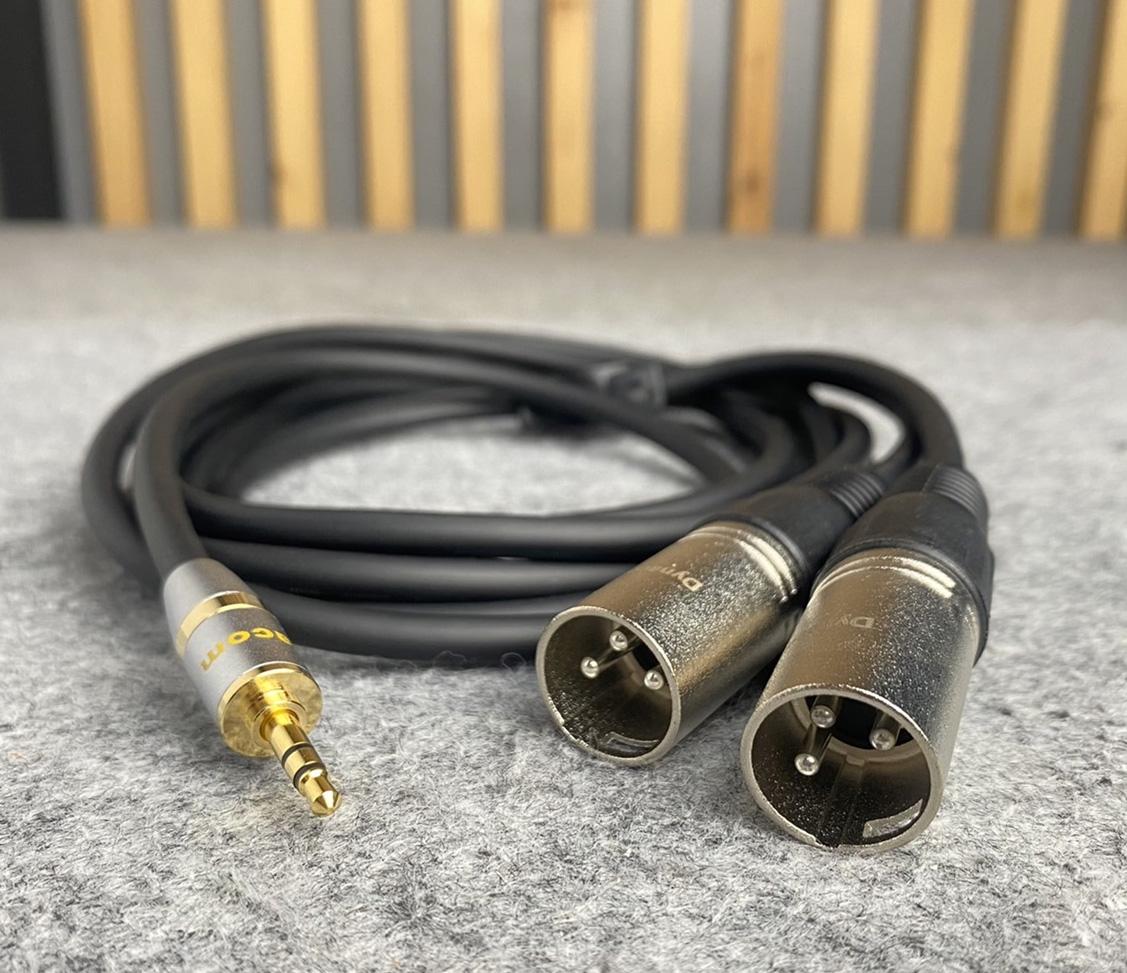
XLR cable Balanced cable One of the most unique types of cable. and the most durable That means you can use very long XLR cables. without fear of loss of audio signal quality or being inserted by noise as well And we often see the use of XLR cables in many types of audio equipment. Especially microphones, speakers, mixers and various PA audio equipment, etc. The reason these audio equipment Use an XLR cable connection, that’s because to guarantee a clear audio signal and stable Whether using a cable length of only 6 feet or longer than 50 feet.
Speakon

Speakon cable is an unbalanced signal cable that we rarely see in homes. or consumer level audio, but often used as a connection cable between power amplifier with speakers in the professional audio industry Because Speakon cables carry unbalanced signals, they are an alternative to TS cables (only for audio equipment with Speakon inputs). high current and can be locked to the Input channel
Banana

Banana cables are a type of unbalanced cable that originated in Europe. It is commonly used by home audio. Connect between the power amplifier and the speakers, especially home theater speakers. Although it looks very similar to an RCA cable on the outside, banana jack cables have a markedly different construction. And it’s designed to make the connection neat. reduce clutter and safer
RCA

RCA cables are another type of unbalanced cable. It’s a common component in home A/V systems, and can also be found in DJ controllers. Because RCA cables are unbalanced, it’s not recommended to use a cable that’s too long. too much
S/PDIF


S/PDIF, short for Sony/Phillips Digital Interface, is a digital audio connection. (Within a distance of not more than 10 meters) by sending signals of S / PDIF, there are 2 types together, that is, Coaxial (RCA) in the form of electrical signals through the cable and Optical (Toslink) that transmits the signal through Optical fiber, which S/PDIF is often found in home A/V audio systems from general consumer to Hi-Fi levels such as TVs, DACs, or even in many Audio Interface models as well.

Add a Comment